
Human nature is complex. Of sympathy and brutality, of boldness and obedience, in one often united in the same individual. In the last hundred years, psychologists have conducted social experiments to appreciate why individuals do what they do in groups. These were studies that were not intended to be entertaining. They did come in as efforts to study actual reactions under controlled conditions. These findings still influence the way we reason in terms of authority, compassion, peer pressure, and morality. Certain discoveries are not comfortable. Others are reassuring. They all support the view that behavior is highly determined by circumstances, framework and social anticipation instead of personality peculiarities alone.
Obedience to Authority – The Milgram Experiment

In the Milgram experiment, the subjects acted under the guidelines of administering what they thought to be painful shocks. A lot of them obeyed the order. According to the study, ordinary people can even follow the orders that go against personal conscience.
Power of Roles – The Stanford Prison Study
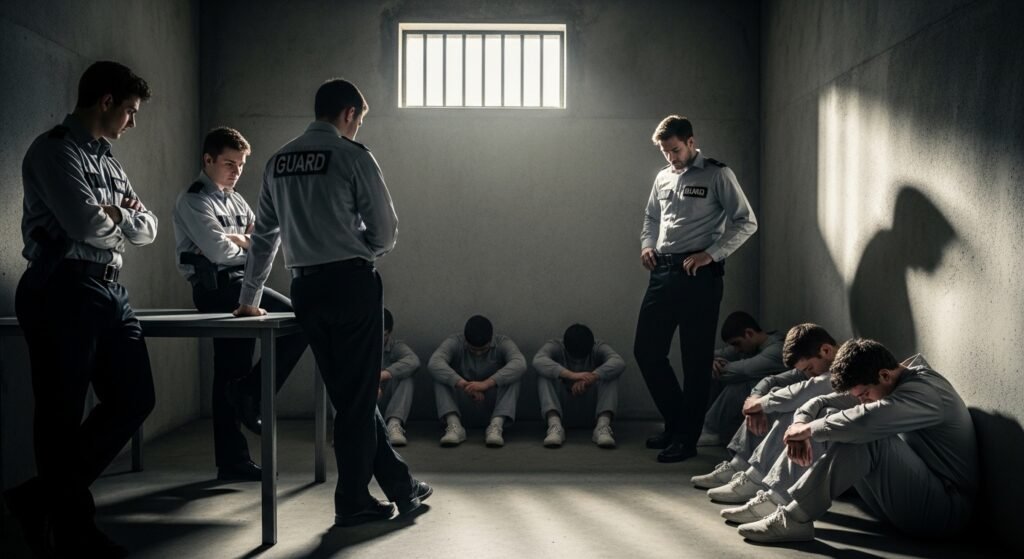
It was found that individuals were able to readily adjust to roles assigned to them, as was witnessed in the Stanford prison experiment. Guards became controlling, and inmates became passive because of the volunteers. Environmental and social roles have the ability to manipulate behavior more than set personality characteristics.
Group Conformity – The Asch Line Study

The findings of the research conducted in the experiments of Asch conformity demonstrated that persons tend to concur with wrong group beliefs. The subsequent results were that many of them conformed to the answers which were obviously incorrect because of fear of being in the wrong. We are influenced by social pressure more than we want to acknowledge.
Bystander Effect – The Kitty Genovese Case

Diffusion of responsibility research came about after Kitty Genovese was murdered. Research indicated that individuals tend not to contribute when in the presence of others. They feel a collective responsibility, hence action is delayed or evaded.
Robbers Cave – Group Conflict and Cooperation

In the Robbers Cave experiment, boys at a summer camp had formed rival groups. Hostility was enhanced due to competition. Hostility was reduced when they had common objectives. General will is able to diminish sectarianism and renew collaboration.
The Halo Effect – First Impressions Matter

Studies that show how a single positive attribute influences the general perception prove the halo effect. In case a person does not seem unconfident or ugly, viewers can think that the person is smart or kind. The impressions of people have an impact on hiring, leadership, and daily communication.
Cognitive Dissonance – Festinger’s Theory

Leon Festinger came up with the concept of cognitive dissonance to describe mental incongruity as a result of beliefs in conflict. Whenever behavior conflicts values, then people tend to change their beliefs in order to bring back the picture back into order. Individuals want sameness, despite the possibility of having to reform memory or opinion.
The Good Samaritan Study – Situational Compassion

Students who rushed to deliver a lecture at Princeton Theological Seminary were less inclined to assist a person who was in distress. Compassion was lessened by time. Situations usually prevail upon idealistic standards.
Learned Helplessness – Seligman’s Findings

Martin Seligman proved that when people are exposed to events whose effects are beyond their control, they may give up. The effort might not recover easily, even in cases where escape is an option. The perceived control is the major issue of motivation and resilience.
The Hawthorne Effect – Behaviour Under Observation

Hawthorne studies found that individuals adjust their behavior upon the knowledge that they are being observed. The only difference was that productivity increased because of attention. The consideration of evaluation transforms performance and attention.
Social Identity Theory – Tajfel’s Minimal Groups

Henri Tajfel demonstrated how readily people become group loyal. Even random grouping resulted in less preferential treatment of the other group. Even with a small identity, fairness, loyalty and judgment are influenced.
